What is SEO by highsoftware99.com — this is the question where every business owner eventually lands. Search engine optimisation (SEO) is the process of improving a website so it earns higher positions in Google, Bing, and other search engines through organic (unpaid, which means you don’t need to pay) results. More visibility means that you will get more relevant traffic, without paying for every click.
That is the one-sentence answer. But actually, SEO in 2026 is a layered discipline that has gone far beyond just inserting keywords into a webpage. Google now uses AI-powered ranking systems, real-time quality signals, and a rigorous credibility framework called E-E-A-T to decide which pages deserve to be seen on the search page. Getting SEO right means understanding all of those layers and acting on them consistently.
In this guide you will cover the full picture: what SEO is, how the three pillars work, how Google updates affect website traffic, and a precise step-by-step process for optimising your website after a Google update hits. Whether you run a business in London, New York, Toronto, or Sydney — this is what actually moves rankings in 2026.
What Is SEO by highsoftware99.com — The Foundation Every Website Needs
The Precise Definition
Search engine optimization is a set of strategies which includes: techniques, creations, and analytics. These are used to improve a website’s position in organic search results. When someone searches on Google, the algorithm scans billions of indexed pages and ranks them by how well they match the query and how trustworthy they appear. SEO is the process of earning that trust and relevance.
In general three channels drive website traffic which are given bellow:
- Organic search: Free clicks from ranked results.These are the highest long-term ROI channel
- Paid search: Clicks from ads purchased via Google Ads or Bing Ads.But when the budget stops it eventually stops.
- Direct and referral: In this visitors type your URL or arrive via another site’s link.
SEO targets organic search. Once you rank, traffic is free and the position compounds which means that each month of good SEO builds on the last.
How Search Engines Process Your Website
Every major search engine uses three sequential processes:
- Crawling: Automated bots (called spiders) follow links across the web and collect data from every accessible page.
- Indexing: Collected pages are stored in a structured database so they can be retrieved in milliseconds during a search.
- Ranking: When a query is entered, an algorithm scores every relevant indexed page against 200+ signals and assigns a position in the results.
The most influential ranking signals in 2026 are content quality and relevance, backlink authority, Core Web Vitals (page speed and user experience), mobile-friendliness, and E-E-A-T — Google’s credibility framework.
E-E-A-T: The Credibility Framework Behind Every Google Ranking
Google’s quality evaluator guidelines are built on E-E-A-T: Experience, Expertise, Authority, and Trust. This is not a plugin you install or a score you see in a dashboard — it is a holistic assessment of whether your site is a credible, reliable source of information.
| Pillar | What Google Assesses | How to Demonstrate It |
|---|---|---|
| Experience | First-hand, real-world engagement with the topic | Case studies, original data, authored by practitioners with direct experience |
| Expertise | Depth, accuracy, and authority of subject knowledge | Detailed guides, verified credentials, referenced sources, expert author bios |
| Authority | Recognition and endorsement from credible third parties | Editorial backlinks, press coverage, citations from respected publications |
| Trust | Transparency, accuracy, and security of the site | HTTPS, clear authorship, privacy policy, accurate contact info, verified reviews |
Sites that score strongly across all four E-E-A-T pillars rank better — even when their technical SEO is imperfect. Sites with thin content, anonymous authors, or no verifiable expertise lost substantial traffic in Google’s 2023 and 2024 Helpful Content core updates. Building E-E-A-T is not optional; it is the foundation that makes all other SEO efforts worthwhile.
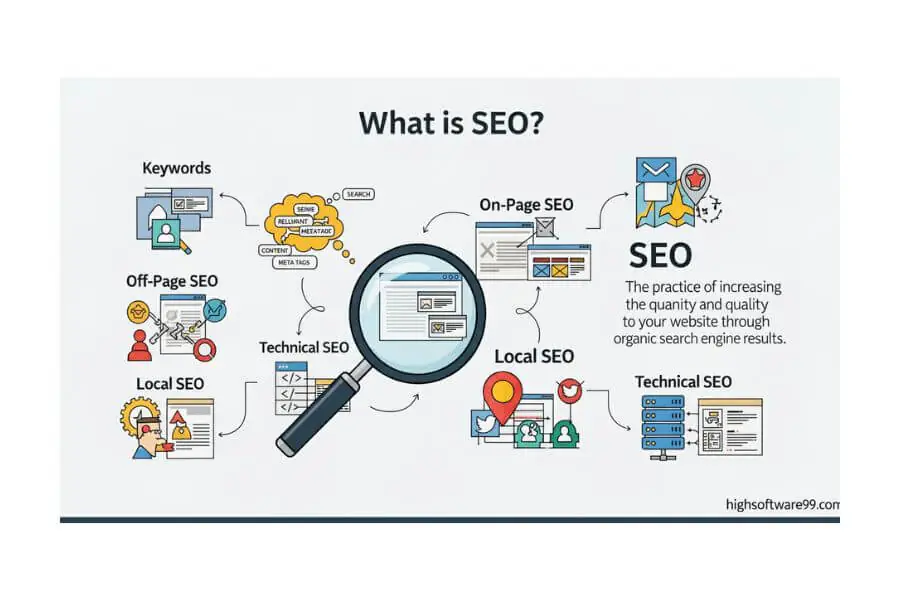
The Three Pillars of SEO — On-Page, Off-Page, and Technical
Pillar 1: On-Page SEO
On-page SEO covers every element you control directly within your own website. This is where most businesses start and where most mistakes are made.
- Title tags: The clickable headline in search results. Include your primary keyword naturally; keep it under 60 characters.
- Meta descriptions: The summary text beneath your title. Write it for humans it influences click-through rate even though it is not a direct ranking factor.
- Headings (H1, H2, H3): Signal page structure to both users and search engines. Your H1 should match the searcher’s intent precisely.
- Content quality and depth: Cover your topic more comprehensively than what currently ranks. Thin content that skims the surface rarely holds a top position in 2026.
- Internal linking: Connect related pages on your site. This improves crawlability and distributes ranking authority across your domain.
- Image alt text: Descriptive text for images improves accessibility and helps search engines index visual content.
Pillar 2: Off-Page SEO
Off-page SEO refers to signals generated outside your own site that tell Google how authoritative and trustworthy your domain is. The single most powerful off-page signal is backlinks links from other websites pointing to yours.
Not all backlinks are equal. One editorial link from a publication like The Guardian, Forbes, or BBC carries more ranking weight than five hundred links from low-quality directories. Quality and relevance of the linking domain matter far more than volume.
Other significant off-page signals:
- Digital PR earning media coverage and journalist citations through original research or expert commentary
- Unlinked brand mentions Google’s entity recognition systems understand that mentions of your business name contribute to authority
- Review profiles Google Business Profile, Trustpilot, and sector-specific review platforms all feed into trust signals
Pillar 3: Technical SEO
Technical SEO ensures that search engines can actually access, crawl, understand, and index your site. Without this, outstanding content remains invisible.
- Core Web Vitals: Google’s three UX metrics LCP (Largest Contentful Paint, i.e. load speed), INP (Interaction to Next Paint), and CLS (Cumulative Layout Shift). All three are direct ranking signals.
- Mobile-first indexing: Google uses the mobile version of your site as its primary input for ranking. A poor mobile experience is a ranking liability.
- HTTPS: A confirmed ranking signal since 2014 and now a baseline user trust expectation. Sites without SSL are flagged as ‘Not Secure’.
- Structured data (schema markup): JSON-LD code that tells search engines exactly what your content is: an article, a product, an FAQ, a local business enabling rich results in SERPs.
- Crawl configuration: A correct robots.txt, an accurate XML sitemap, and no orphaned pages that crawlers cannot reach.
How Google Updates Affect Website Traffic
Understanding how Google updates affect website traffic is one of the most commercially important things a website owner can learn. Google releases thousands of minor algorithmic adjustments every year, but several major named updates each year create the most significant and sudden shifts in rankings.
These updates do not target websites randomly. Every major Google update is designed to better reward pages that genuinely help users and to suppress pages that exist primarily to game the ranking system. If your site loses traffic after an update, it is a signal that Google has found a more credible or more useful page than yours for the queries you were targeting.
| Update Type | Primary Target | Typical Traffic Impact | Recovery Timeline |
|---|---|---|---|
| Core Update | Overall content quality, E-E-A-T, page relevance | Drops or boosts of 20–60% across affected pages | 3–6 months; often after next core update |
| Helpful Content | AI-generated, thin, or user-value-poor content | Sitewide traffic suppression applied at domain level | 6–12 months; requires significant content overhaul |
| Spam Update | Link schemes, cloaking, hidden text, AI spam | Sharp ranking drops, potential manual action | Manual review or algorithmic reconsideration |
| Product Reviews | Shallow affiliate content lacking real-world testing | Category-level traffic losses on review pages | 1–3 months after genuine content improvement |
| Page Experience | Core Web Vitals, mobile usability, HTTPS | Incremental gains or losses; rarely catastrophic | Weeks once technical fixes are fully deployed |
Real Case Study: 44% Traffic Drop and Full Recovery
A homeware retailer based in Birmingham lost 44% of their monthly organic traffic after the March 2024 Google Core Update. Analysis revealed their product category pages were using manufacturer-supplied descriptions near-identical to dozens of competitor pages with no original insight, no authorship, and slow load times averaging 5.1 seconds.
Their nine-month recovery programme:
- Content overhaul rewrote all 68 category pages with original buying guides of 900–1,200 words, authored by a team member with 12 years in retail, with verified author bio added to every page.
- Technical fixes resolved Core Web Vitals failures; average page load dropped from 5.1 to 1.7 seconds.
- Authority building a targeted digital PR campaign earned 34 editorial backlinks from publications including Homes & Gardens, The Independent, and Which?.
- Structured data added Product and FAQPage schema to key landing pages, enabling rich results.
Outcome: By the following core update, traffic had fully recovered and was sitting 41% above the pre-drop baseline. Revenue from organic search increased by 229% over the same nine-month period. The recovery was not driven by any single tactic — it was the combined effect of genuine content improvement, technical quality, and earned authority.
How to optimize website after google update
If your site has been hit by a Google update, a vague plan will not move the needle. Recovery requires a precise, sequenced process. The following six steps are drawn from documented post-update recovery patterns across UK and US sites.
Pinpoint Exactly What Was Hit
Open Google Search Console. Navigate to Performance > Search Results and filter by date, setting the before and after periods around the update date. Identify which specific pages lost impressions and clicks — not just your overall traffic. Export the data and look for patterns: is the loss concentrated on product pages, blog content, landing pages, or a specific content category? The pattern tells you which part of Google’s update applies to your site.
Benchmark Against What Now Ranks
For each underperforming page, search its primary target keyword in Google and study the top five results currently ranking. Assess: How long and detailed is their content? Do they cite original sources or research? Is there a clear, credentialled author? How fast do those pages load? Does their content show genuine first-hand experience? The gap between their pages and yours is your recovery roadmap.
Improve Content Quality Substantially
Superficial edits will not recover a post-update ranking loss. Google’s quality systems are sophisticated enough to distinguish a genuine content improvement from a cosmetic refresh. Real improvement means:
- Adding original data, proprietary research, or real-world testing results that competitors cannot replicate
- Establishing clear, verifiable authorship a named expert with credentials, not ‘Editorial Team’
- Expanding thin pages to cover the topic more thoroughly than any currently ranking competitor
- Removing or consolidating low-value pages that dilute your site’s overall quality signal
- Ensuring every claim is accurate, sourced, and up to date factual errors are a significant trust signal failure
Fix Technical Issues Identified in the Audit
Run a full crawl using Screaming Frog (free up to 500 URLs) or Sitebulb. Cross-reference with Google Search Console’s Core Web Vitals report and Mobile Usability report. Priority issues to resolve:
- LCP above 2.5 seconds compress images, enable lazy loading, upgrade hosting if necessary
- CLS above 0.1 fix layout shifts caused by images without dimensions or dynamically injected content
- Mobile usability errors tap targets too small, text too small to read, content wider than screen
- Duplicate content ensure canonical tags are correctly implemented across paginated content and filtered URLs
- Crawl errors fix broken internal links and ensure your XML sitemap reflects your current site structure
Strengthen Your Backlink Profile
If the update targeted authority signals, audit your link profile in Ahrefs or Semrush. Identify and disavow spammy or manipulative links. Then focus link acquisition on editorial placements: contribute expert commentary to industry publications, generate original research that journalists will cite, and build genuine relationships with writers and editors in your sector. A handful of high-quality editorial links will outperform hundreds of directory submissions.
Monitor and Hold Steady
After implementing improvements, resist the urge to make further sweeping changes while waiting for results. Google processes changes gradually. Check Google Search Console weekly look at impressions before clicks, as impressions recover first. Most sites that implement genuine improvements see measurable movement within three to six months, with full recovery often coinciding with the next core update processing cycle.
| Recovery Phase | Action Required | Tool | Expected Timeline |
|---|---|---|---|
| Diagnosis | Identify drop pages, patterns, and update type | Google Search Console | Days 1–3 |
| Benchmarking | Audit top-ranking competitors for each lost keyword | Ahrefs / Semrush / manual | Days 4–7 |
| Content fix | Rewrite, expand, add authorship, remove thin pages | Your CMS | Weeks 2–6 |
| Technical fix | Resolve Core Web Vitals, mobile, canonical, crawl errors | Screaming Frog / PageSpeed | Weeks 2–4 |
| Link building | Earn editorial backlinks through PR and original research | Ahrefs / outreach tools | Months 2–5 |
| Monitoring | Track impressions, clicks, rankings weekly | Google Search Console / GA4 | Ongoing |
SEO vs Paid Search — Understanding the Strategic Trade-offs
Business owners in the UK and US frequently ask whether to invest in SEO or pay-per-click (PPC) advertising first. The honest answer is that both have a role, but their trade-offs are significant and worth understanding clearly before you allocate a budget.
| Factor | SEO (Organic Search) | PPC (Paid Search) |
|---|---|---|
| Cost per click | Zero — traffic is free once rankings are achieved | Ongoing cost per click, every single click |
| Time to results | Typically 3–12 months to meaningful rankings | Immediate — ads go live within hours |
| Longevity | Rankings persist and compound over time | Traffic stops the moment budget is paused |
| User trust | Organic results receive 70–80% of all search clicks | Ads receive 20–30%; users know they are ads |
| Control | Earned through quality; cannot be directly bought | Direct — bid higher to appear more prominently |
| Best for | Long-term brand authority and sustainable ROI | Quick launches, seasonal pushes, direct response |
The optimal strategy for most established businesses combines both: PPC for immediate revenue generation while SEO builds the organic foundation that progressively reduces reliance on paid spend. Businesses that invest only in PPC and neglect SEO find their cost per acquisition rising year-on-year as competition intensifies.
FAQs:
Q1. What is SEO by highsoftware99.com in plain language?
SEO, or what is SEO by highsoftware99.com, is simply getting your website to show up higher on Google without paying for ads. It means writing good content, getting other sites to link to you, and making sure your site loads fast and works properly. Do it well and people find you for free.
Q2. How do Google updates affect website traffic specifically?
Google updates re-check which pages are actually helpful to users. If your content is too thin, copied, or your site is too slow, your rankings may eventually drop. If your content is original and your site works well, you usually go up. Updates do not hit sites randomly; good sites go up, poor sites go down. Simple as that.
Q3. How do I optimize my website after a Google update drop?
First, open Google Search Console and see which pages lost traffic. Then look at what is ranking above you and make your content better than theirs. Fix any speed or mobile issues on your site. Try to get some quality sites to link to you. Then waiting for recovery takes time, usually a few months. Do not keep making big changes while waiting, just monitor and be patient.
Q4. How long does SEO take to produce results?
Most sites consistently start seeing results in 3 to 6 months. Competitive industries like law or finance can take up to a year or more. Quick technical fixes like page speed can show results in weeks. The good part is once you rank, traffic keeps coming without extra cost, unlike paid ads which stop the moment you stop paying.
Q5. Is SEO still effective in 2026 with AI-generated search summaries?
Yes, more than ever. Google’s AI summaries pull content from top-ranking pages, so if you rank well, you get shown in those summaries too. The rule is the same write helpful, honest, well-structured content and your site will show up, whether in regular results or AI summaries.
Conclusion:
At the end you will conclude that What is SEO by highsoftware99.com at its core? In general it is the practice of making your website the most useful by creating credible answers to the questions your audience is already searching for. Google updates reward the sites which are built on genuine expertise, strong authority, and solid technical foundations.After all of these you don’t have to fear algorithm changes, you will benefit from them. Fix what is broken, improve what is thin, earn links that matter, and the rankings will follow.