
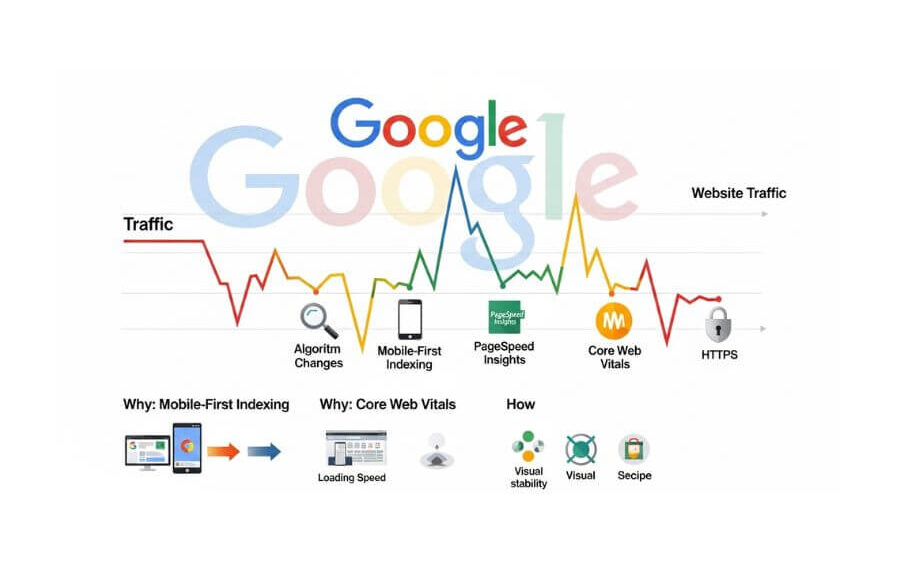
Google updates also influence traffic on the websites greatly since they are used to rank the sites in the search results. It is crucial that marketers and site owners learn about how Google Updates Affect Website Traffic of websites in order to keep the organic activity steady. The changes in algorithms, core updates, and specialized updates, such as Page experience or Spam updates, may increase or decrease traffic. A sudden decrease of impressions and clicks on websites that do not adapt, and growth of visibility and steadiness in search results on optimized websites can be observed.
Why is it important to know the Google Algorithm Updates?
Google algorithm changes are the periodic changes in how search results are rated and assessed. The core updates change the ranking criteria of pages across the world, and affect the manner in which pages are evaluated in terms of relevance, authority, and content. On the factual note, thin content, slow loading,g and low mobile usability sites are likely to lose traffic following core updates. The Page Experience Update is a specialized update focusing on user-oriented measures like Core Web Vitals; the Spam update is aimed at manipulative or low-quality content that does not comply with the rules of Google.
The impact of Core Updates on Website Traffic.
Core updates tend to cause quantifiable traffic changes in industries. The research of SEO shows that approximately 30-40 percent of websites undergo alterations in impressions and clicks after a core update. Authoritative websites that have new content that is of high quality tend to get visibility, whereas websites that have content that is outdated or irrelevant may experience losses. Factually, the ability to track traffic using Google Search Console and analytics tools right after a core update can be used to detect the impacted pages and propose changes to the optimization strategy.
Expert Updates: Page Experience and Spam.
The Page Experience change by Google lays emphasis on the usability of the site, its speed, and mobile responsiveness. Websites that are optimized in terms of Core Web Vitals, a large Largest Contentful Paint (LCP) value, and low Cumulative Layout Shift (CLS) tend to have incremental increases in traffic. On the other hand, the ranking penalties can be applied to sites whose LCP is slow or has high CLS. Spam updates are directed towards getting rid of manipulative SEO practices. Keywords stuffing, cloaking, or poor-quality link schemes on websites often result in a temporary drop in traffic following these changes, as a series of post-update SEO audits reveals.
Seasonal and Algorithmic Adjustments.
Google also has minor changes in its algorithm in the course of the year, in addition to the big ones. Such changes are usually based on the user behavior, trending topic,s or seasonal search trends. As an example, the ranking of e-commerce sites can change during the main shopping seasons as the algorithm will prioritize timely and authoritative content. Monitoring these micro-adjustments will enable the brands to have consistent traffic even when the core updates are not in the spotlight.
Strategies of Recovery and Adaptation.
The potential of traffic reduction due to Google updates can only be addressed through a holistic approach. It is necessary to carry out a complete SEO audit, revise thin or outdated texts, and enhance technical performance. In fact, lost ranks are usually regained through optimization of page speed, correcting mobile usability, and ensuring that there are backlinks. Also, competitor analysis will offer information about new trends and changes in user behaviour so that the brands can coordinate their search engine strategies with the post-updating search patterns.
Table: Google Updates and Their Website Impact
| Google Update Type | Impact on Website Traffic | Key Factors Affected | Recommended Action |
| Core Updates | Major fluctuations in impressions & clicks | Content quality, authority, relevance | Audit content, optimize authority & UX |
| Page Experience Update | Incremental traffic changes | Core Web Vitals, mobile usability | Improve LCP, CLS, FID, and mobile responsiveness |
| Spam Updates | Sudden traffic loss | Low-quality content, manipulative SEO | Remove spam, fix link issues, clean SEO |
| Seasonal Adjustments | Minor ranking shifts | User behavior, trending topics | Optimize content for trends & seasonality |
Final Thought
By 2026, it will no longer be an option to comprehend the way in which Google updates influence the traffic on web pages, but it will be mandatory to succeed in the online arena. Sites tracking changes in the algorithm, adjusting technical and content policies, and paying attention to the user experience have more chances to ensure stable traffic and enhance search visibility. Although conventional SEO generates authority, LLM and AI-related discoveries, along with a timely response to Google changes is the competitive advantage towards sustainable organic growth.
FAQs:
What is a Google core update?
A Google core update is a wide-ranging alteration of the search algorithm that influences the ranking variables of all sites. Core updates are those that normally affect content relevancy, authority, or user experience with the resultant effect of a quantifiable change in traffic.
What is the impact of Google updates on the traffic of websites?
The update of Google can make or break a site in traffic based on the match of the site with the new ranking factors. Quality content and good user experience websites tend to be visible, whereas old and low-quality websites tend to lose traffic.
What is the Page Experience update?
The Page Experience update measures the sites on the basis of the Core Web Vitals, mobile usability, and safe browsing. Speed, stability, and interactivity optimized pages tend to improve traffic.
What are the effects of Spam updates to websites?
Spam updates attack manipulative search engine optimization (SEO) techniques, including keyword stuffing, link schemes, or cloaking. The websites that indulge in these tricks tend to experience a sudden decline in traffic until the violations are resolved.
How are seasonal changes going to affect the traffic in a website?
The algorithm used by Google occasionally changes rankings depending on the time of year or user behavior. To illustrate, e-commerce websites can become visible during the times of holiday shopping because of the timeliness of the content and seasonal indications.
What is the speed of update response to the core?
Analytics and Search Console are the main tools that should be checked by Webmasters right after a core update. Remodelling content and enhancing usability and technical defects within weeks can restore lost traffic.
Do traffic improvements by improving Core Web Vitals depend on traffic?
Yes, websites with improved Core Web Vitals load faster, are more aesthetically stable and respond to user touch, which tends to increase incremental traffic after updates that focus on user experience.
Is competitor monitoring useful following updates?
Competitor monitoring identifies content that was seen and pages accessed, which will tell about new trends. This information will help brands adjust their content strategy and to recover or gain traffic.
Do all Google updates go global?
Updates to the core are generally universal, but there is a regional or industry-oriented specialized update. Localized content optimization is important in businesses that have a focus on certain geographies.
What can I do to avoid the loss of traffic during updates?
The possibility of losing traffic is minimized by the maintenance of high-quality, regularly updated content, quick-loading pages, a mobile-friendly design, and appropriate SEO practices. Stability is crucial in terms of regular audits and keeping up with changes in the algorithms.
How to optimize website after Google update?
The process involves conducting SEO audits, improving content quality, fixing technical issues, and aligning with updated ranking factors.