
Introduction: Why Your Dashboard is the Nerve Centre of Modern Work.
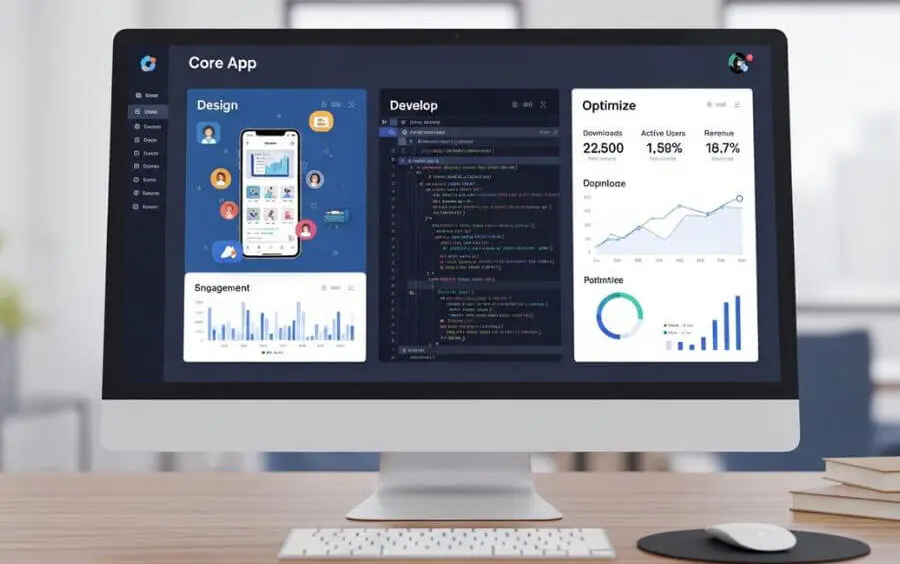
Core App Dashboard is an all-in-one digital platform that consolidates your most frequent applications, data streams, and workflows into a single and usable place. Simply put, it lets you know what is going on in all of your tools, simultaneously, and without the need to flip through a dozen open tabs.
Having the appropriate dashboard in place is no longer a luxury whether you are dealing with a school setup, a business or managing an enterprise IT setup. It is the basis of effective, informed decision-making.
Still, there are numerous organisations that do not have a consistent strategy. They are dependent on fragmented tools, isolated reports and manual updates. The result? Missing time, missed notifications, and exasperated organizations. This guide is there so as to alter that. We go through the fundamental app dashboard log-in configurations to the advanced core app dashboard construction tools, we have it all that you need to know, practically and comprehensively.
What Is a Core App Dashboard? An Understood, Operating Definition.
Regarding the design of the information technology core app dashboard, a dashboard is not simply a screen with charts. It is a dynamic and interactive space where information from various sources are integrated. Imagine it was the control tower of your online business.
A dashboard at its simplest form is a collection of measures, notifications and action in real time. The core in core app dashboard can be understood as the major applications that are vital to the operations or the role of a user or an organisation.
Salesforce, Slack, and Google Analytics may be the essential applications of a sales team. The applications essential to a school administrator may consist of a student management system, a calendar application, and communication application. All of them are united with the dashboard, in a clean and logical way.
The Major Elements of a good dashboard.
| Component | Purpose | Example Tool |
| Data Widgets | Put metrics and KPIs on the screen. | Klipfolio, Geckoboard |
| Navigation Panel | Fast access to essential applications. | Microsoft Teams, Notion |
| Notification Centre | Action items and alerts on the surface. | Slack, Asana |
| User Roles & Permissions | Who sees what and who sees who. | Admin settings, SSO |
| Search & Filter | Find information fast | Elastic search, native search |
| Customisation Tools | Customise set-up and content. | Drag-and-drop builders |
Core Dashboard App vs Generic Dashboard: The Difference.
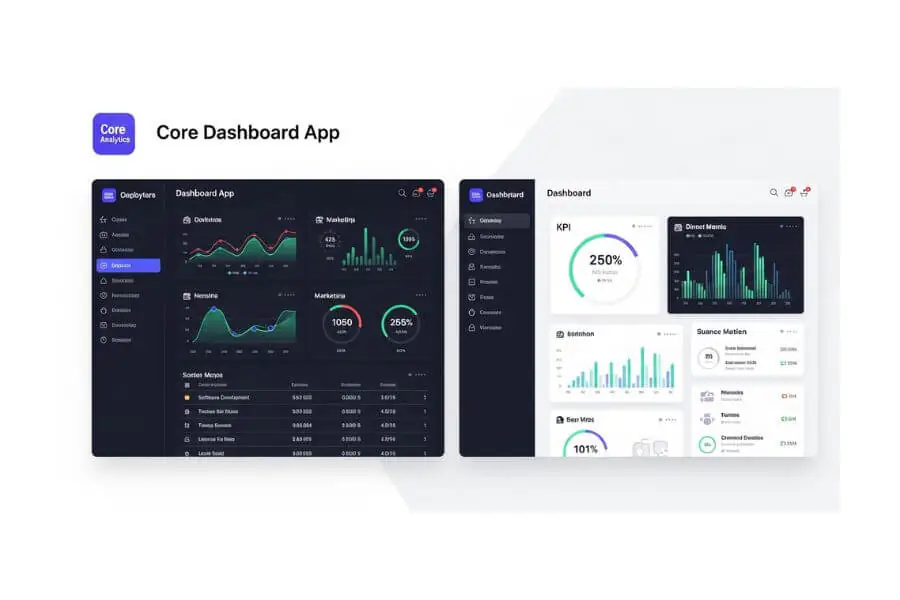
Dashboards are not all created equal. You may have a generic dashboard that tells you about revenue or web traffic. A core dashboard application instead is designed specifically around your most essential tools and processes.
This difference is significant since an essential dashboard is highly integrated. It does not just drag data, it interrelates things to do. Using one screen you are able to accept a request in your project management software, look at the status of a customer in your CRM, and reply to a team message. It is that kind of integration that makes it truly transformative.
Core Dashboard App: The Features that really matter.
- Real-time syncing of data – automatic updates, no refresh.
- Role-based views – each user will have what is relevant to him or her.
- Cross platform compatibility – desktop, tablet, and mobile compatible.
- Single sign-on (SSO) tool – a single login to all the tools that are connected.
- Customizable alerts – more of a proactive, not a passive data.
- User activity and compliance Track changes and audit trails.
Canvas Core App Dashboard: An Education Use Case in the Real World.
The canvas core app dashboard is one of the most talked about applications in the education sector. Canvas is a popular learning management system (LMS) that is used by numerous schools and universities in the UK and the US. It has a special dashboard that places the most crucial tools of a student or a teacher in the centre.
The Canvas dashboard allows organising courses, assignments, announcements, and grades into one view. The teachers are able to notice that there are students who are lagging behind. Students are able to follow future deadlines without having to open each course separately. Administrators are able to track the engagement data at the departmental level.
The way Universities are using it.
A medium-sized university in the UK implemented Canvas as the main LMS on the basis of the replacement of a legacy system. During the first semester, employees indicated that the support emails concerning the question of where do I find things decreased by 35%. The user-friendly design of the dashboard also implied that full-time students and part-time students would manage their coursework with little friction.
The institution linked its library database and timetabling system to Canvas dashboard, as well. Students were able to check their schedule, check the availability of books and send in their assignments without leaving a single interface. That is the effective ability of a properly applied core app dashboard.
Core App Dashboard Login: Gaining Access to the First Thing First.
The core app dashboard login procedure is not always considered seriously. Most organisations consider it as a very technical process of simply getting users in the door. As a matter of fact, the experience of logging in defines the way individuals interact with the dashboard since the first day.
Best Practices to Dashboard Login Setup.
- Single Sign-On (SSO) should be used when practical. Such tools as Okta, Microsoft Azure AD, and Google Workspace enable people to log in once and have access to all the applications connected with them. This removes the hassle of having to remember a number of passwords.
- Facilitate multi-factor authentication (MFA). Particularly significant with dashboards which expose sensitive business information or student files. MFA will provide an extra level of protection and does not affect usability greatly.
- Establish role-based access on the initial level. Who should see what? Before going live, specify who is to see what. The HR payroll information should not be accessible to a sales executive and a student to another student.
- Offer effective onboarding to new users. However, a short guided tour or tooltip layer on the initial login saves a lot of support calls and it speeds up adoption.
- Monitor login activity. Establish alerts on atypical times or places of logging in. Dashboard environments usually carry sensitive information and irregularities are supposed to raise immediate examination.
Core App Dashboard Building Tools: Selecting an Appropriate Platform.
Core App Dashboard Building Tools are no-code drag-and-drop platforms to full customisable developer frameworks. The correct decision will be based on your technical ability as a team, the simplicity or not of your sources of data and the level of flexibility you require.
The Trending Dashboard Building Systems in 2025.
| Tool | Best For | Skill Level | Pricing Model |
| Microsoft Power BI | Enterprise data analytics | Intermediate | Subscription |
| Notion | Team wikis, project hubs. | Beginner | Freemium |
| Retool | Internal business tools | Developer | Per-user |
| Klipfolio | Marketing and KPI dashboards. | Intermediate | Subscription |
| Tableau | Deep data visualisation | Advanced | Subscription |
| AppSmith | Open-source app dashboards | Developer | Free / Cloud |
| Canvas (LMS) | Education environments | Beginner–Intermediate | Institutional |
How to Evaluate Building Tools.
- Native Android interoperability with your existing software stack.
- Non technical drag and drop interface.
- Custom data connection access using API.
- Mobile user responsive design.
- Version control and audit logs.
- Compliance with GDPR and data sovereignty (vital to organisations in the UK)
Case Study: How a UK Retail Organization Remedied Operations by a Core App Dashboard.
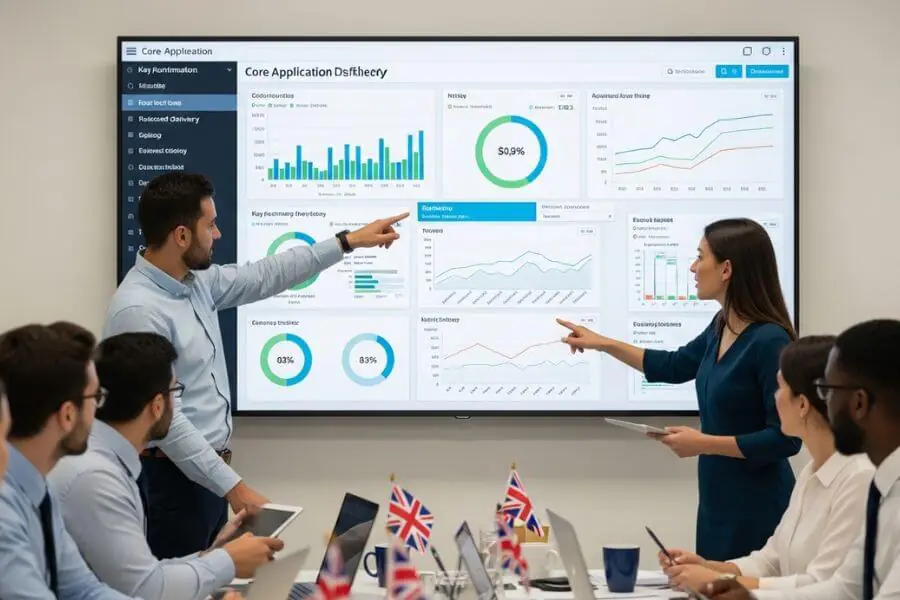
A local UK fashion retailer having 18 stores and an online store was experiencing difficulties with operational visibility. Their team utilized seven various tools on a daily basis, which were Shopify as an online selling platform, a personalized inventory management system, Microsoft Teams to communicate, Google Sheets to plan, and individual channel-specific reporting tools.
Each Monday, two employees took about four hours to extract data of each source in one spreadsheet to be presented to the management. This was a process that was prone to errors, time consuming and always a bit out of date by the time the meeting commenced.
The Solution
This company collaborated with a UK based digital agency to create a bespoke core application dashboard with Power BI as the data layer and Notion as the team cooperation platform. The dashboard retrieved live information of Shopify, their inventory system and Google Analytics. It had automatic refresh after every 15 minutes so that there was always up-to-date data.
Role-based views were set in such a way that the store managers could only view the data of their store in comparison to the company-wide benchmarks. The e-commerce department experienced channel-based measures. The MD had an overview of all sources on the highest level.
The Results (6 Months Post-Launch).
| Metric | Before Dashboard | After Dashboard |
| Time spent on weekly reports. | 4 hours/week | Under 20 minutes/week |
| Problems related to data accuracy per month. | 12–15 instances | 1–2 instances |
| Time to determine stock issues. | 24–48 hours | Under 2 hours |
| Staff satisfaction score (internal survey) | 62% | 84% |
| Decision meeting duration | 90 minutes average | 45 minutes average |
Nothing exotic or expensive on the enterprise scale was introduced in the business. They took the tools available and integrated them in a manner that made sense and developed a dashboard that suited their team dynamics. That is the lesson that most organisations fail to learn.
Information Technology Core App Dashboard: Perspective of the IT Professional.
The design of the information technology core app dashboard is a field on its own. IT managers and system administrators can have their own special problems: maintaining a bloated software portfolio, maintaining data confidentiality, maintaining up-time and supporting users of wildly different technical skills.
The dashboard is also a control surface in terms of IT governance. It is where you check the health of systems, track licence usage, do provisioning of users and implement compliance policies.
IT Dashboard Must-Haves
- Infrastructure monitoring Server uptime, CPU load, network traffic.
- Licence tracking software – prevent excessive expenditure or infringements.
- Control of user access who can access what and when.
- Integration of incident management – integrate with ticketing systems such as ServiceNow or Jira.
- Threat detection SIEM integration Security event monitoring.
- Status of backup and disaster recovery – ensure that important data of the business is safeguarded.
IT dashboards should also be used to reveal the data processing records, consent records, and breach notification schedules in UK organisations that act under GDPR and UK Data Protection Act 2018. It is a great idea to build compliance visibility into your dashboard early in life to save a lot of work in the future.
Introduction: How to Build Your Own Core App Dashboard: A Step-by-Step Guide.
Step 1: Set up Your Core Apps and Data Sources.
Name all the applications that your team uses on a daily basis. Next, put them in order of frequency and business impact. The top five to eight should be preempted on your dashboard. Too many applications will be a waste of use and defeat of the objectives.
Step 2: Determine Your Key Metrics.
What do you think success is like in your job or company? Identify five to ten KPIs that are important. These form the dashboard stars. Avoid the urge to include all the metrics that you can have. Clarity is better than comprehensiveness.
Step 3: Select Your Building Tool.
Adapt the tool to your technical environment and data. In the case of a non-technical team, Power BI with pre-built connectors or a program such as Notion can be adequate. When you require custom logic or data transformation, have a look at an option that is developer friendly such as Retool or AppSmith.
Step 4: Map User Roles and Permissions.
Define your user groups before creating one single widget. What does an administrator view as compared to a normal user? Role-based access is not merely a security feature, but it allows the dashboard to be more helpful as it brings about the relevant information to every individual.
Step 5: Iterative Development and Testing.
Attempt not to create the ideal dashboard at once. Begin with three to four fundamental data links, take feedback of actual users and repeat. The majority of the failed dashboards have failed because they have been constructed by technical staff without continuous contributions of the people who will be the users of such dashboards.
Step 6: Have a Maintenance and Review Cadence.
Dashboards are not pre-configured tools. Applications update. KPIs change. Businesses evolve. Arrange a quarterly review to determine whether your dashboard is still indicative of your present state of operational reality. Retire outdated widgets. Introduce new integrations when they are applicable.
Comparison of Dashboard Approach: Quick Reference.
| Approach | Setup Time | Customisation | Cost | Best Fit |
| Off-the-shelf SaaS | Days | Low–Medium | Monthly subscription | SMBs, quick starts |
| Custom-built (in-house) | Weeks–Months | Very High | Developer hours | Big orgs, complicated requirements. |
| Hybrid (SaaS and custom API) | 1–4 weeks | High | Moderate | Growing businesses |
| LMS-embedded (e.g. Canvas) | Days | Medium | Institutional licence | Education sector |
| No-code builder | Days | Medium | Freemium to low | Non-technical teams |
The mistakes that should not be made in establishing a core app dashboard.
- Constructing IT, not the user. The dashboard should be useful to the individuals who will use it in their daily life and not the individuals who are going to construct it.
- Overloading with data. Increased data is not improved data. Develop an emphasis on decision motivation.
- Ignoring mobile users. Various teams use tablets and phones to access dashboards. Pilot test prior to launching.
- Bypassing the security check and the login. Data that may be sensitive to the business or the individual may be revealed through a weakly secured dashboard.
- Ignoring the need to train users. An excellent dashboard will be a wasted feature even when individuals are not aware of how to maximize it.
- Failure to link up real time data. Fixed report cards on the dashboard go stale very fast and lose their credibility.
FAQs:
1. What is a Core App Dashboard?
A Core App Dashboard is a single digital experience that integrates the most critical business applications, data and processes of an organisation into a single view. It allows making decisions quicker, minimizes the time spent on switching the tools, and enhances the visibility of operations across teams.
2. What is the distinction between a core dashboard application and an ordinary dashboard?
Core dashboard app is uniquely created according to your primary tools and workflows so that it can be acted upon and seen. An ordinary dashboard usually presents information only. These are core dashboards, interactive and user roles customized.
3. What is the process of creating a Core App Dashboard login which is secure?
Single Sign-On (SSO), multi-factor authentication (MFA), role-based access control, and reviewing the activity of logging in should be used to detect anomalies. Such tools as Okta, Azure AD, and Google Workspace make this process much easier.
4. What is a Canvas Core App Dashboard?
The primary interface of the Canvas LMS (Learning Management System) is the Canvas Core App Dashboard that is popular in schools and universities in the UK and US. It brings courses, assignments, grades and communications together in one easy to use screen by the students, educators and administrators.
5. What are the most Recommended Core App Dashboard Building Tools?
The best tools are Microsoft Power BI, Klipford, Retool, Notion, tableau, and AppSmith. Depending on the level of technical skills of your team, the complexity of your data, and your budget, the best option is depending on your choice. The majority of organisations find it advantageous to do a low-code or no-code first, then think of custom builds.
6. What is the difference between an information technology core app dashboard and a business dashboard?
A dashboard with an IT-focus would generally unveil infrastructure metrics, security events, licence utilization and system health. A business dashboard is concentrated on such KPIs as revenue, sales, or project development. The existence of both is beneficial to many organisations, having different role-based views in one platform.
7. Is a core app dashboard useful to small businesses?
Absolutely. Small enterprises are usually the greatest beneficiaries since they do not have huge reporting departments. One easy dashboard between two or three main tools such as Shopify, Xero, and Google Analytics can save hours of manual work every week and provide the owners with true insight into the performance of their business.
8. What is the frequency of updating my dashboard?
Check your dashboard at least once every three months. With every shift in your tools, KPIs, or team structure, your dashboard ought to change as well. The day-to-day freshness is managed by real-time data connections, however, the layout and its content require a human review to remain strategically pertinent.
9. Can a core app dashboard be constructed without knowledge of coding?
Not at all. Such tools as Notion, Power BI, and Klipfolio are non-technical. Drag-and-drop interfaces and ready-to-use integrations enable an experienced non-developer to create a useful connected dashboard within days.
10. What is the security consideration to dashboards in the UK?
The UK organisations should adhere to GDPR and UK Data Protection Act 2018. It involves keeping personal data that is shown in dashboards lawfully, only the authorised users have access, policy of data retention is in place, and the breach of the policy can be detected and reported in 72 hours.
Summary: Develop the Core App Dashboard Your Team Really Needs.
The best Core App Dashboard is not the one that is the most technical. It is the one that your team goes to each morning, and trusts fully and actually uses to make better decisions quickly.
Since education settings using Canvas adopt retail companies integrating Shopify and stock information, the organisations that gain the most out of their dashboards have one thing in common: they were designed around actual processes, rather than idealized concepts.
Begin with your central applications. State your most significant measures. Select a building tool of the capability of your team. Get the permissions and the logins correct on the first day. Then repeat, listen to your users and continue to improve.
You do not want to go to your dashboard. It is a dynamic tool that expands as your organisation does. Construct it carefully, keep it up, and it will give dividends in time saved, decisions made better and operational confidence acquired that will last many years.