

Introduction: The Question Which Nobody Dared to Ask
Yes, does ChatGPT use water, and the answer may be a real shocker. Whenever you ask ChatGPT a question, provide a prompt, or generate an image, there is real physical water that is used in the real world. Not virtually. Not metaphorically. The data centres that drive these AI conversations are cooled using actual water which is supplied by municipal or industrial sources.
It is not a peripheral issue and a hypothetical green concern. It is an empirical, recorded fact that has been quantified by the foremost researchers at the University of California, Riverside and University of Texas, Arlington in peer-reviewed articles. To the majority of users in the UK, the US and elsewhere, however, it is entirely inconspicuous.
This article cogs into the entire picture: how much water does ChatGPT use per query, one day and at scale – and what it implies to the future of AI sustainability.
How Does ChatGPT Use Water? The Mechanics Explained
How does ChatGPT use water is a question that is based on fundamental thermodynamics. Large language models require huge quantities of heat to be generated by their GPUs and TPUs. In order to avoid failure of the equipment, data centres invest in advanced cooling systems – and a significant part of the systems use water.
The Cooling Loop: From Server Heat to Water Evaporation
The servers used during ChatGPT prompt processing create heat. It has to be removed as quickly and efficiently as possible. The most prevalent data centre cooling mechanism in large-scale data centres is evaporative cooling or in simple terms, a cooling tower system. Here is how it works:
- Hot air of the server racks is directed to a cooling device.
- Water moves through heat exchangers, and it absorbs thermal energy of the air.
- The warm water is then in coolers where it evaporates to some extent.
- The evaporation removes heat in the system – and water evaporated is lost to the atmosphere.
- The fresh water has to be fed continuously into the system to replenish that which evaporates.
This is a consumptive use as opposed to water that is utilized and recycled to a source. The water that has been evaporated is lost – it cannot be captured back in the field. That is why the data centres are listed as major consumers of water in terms of environmental impact assessment.
The Reason Why AI Models Are Particularly Water-Intensive
Water is also used by the traditional web servers, streaming platforms, and cloud storage but at a fraction of the intensity of generative AI. This is due to the computational density. A query on a large language model such as GPT-4 would use orders of magnitude more computations on the GPU than a typical search query result or database query.
Indeed, researchers Li et al. (2023) reckoned that training GPT-3 alone used around 700,000 litres of fresh water – the same amount used to cool 370 BMW M5 cars throughout their entire production cycle. The working stage – all the calls you and millions of others make – is a lot on top of that.
How Much Water Does ChatGPT Use Per Question?
How much water does ChatGPT use per question is one of the most common sub-questions on this subject, and some researchers have provided some specific estimates.
As per the article Making AI Less Thirsty by Shaolei Ren et al. 500ml of water, about one and a half full glasses, is used by ChatGPT to address 5 to 50 queries. That translates to roughly:
| Query Volume | Computed Water Consumption | Real-World Equivalent |
| 1 query | ~10-100 ml | A few sips of water |
| 10 queries | ~100 ml – 1 litre | A standard glass |
| 50 queries | ~500 ml | A standard water bottle |
| 100 queries | ~1-2 litres | A large water bottle |
| 500 queries | ~5-10 litres | A bucket of water |
These numbers are dependent on the location of the data centre, the outside temperature, the exact model being enquired about and the facility employs a hybrid system or entirely evaporative cooling. Hotter or drier data centres (such as those in some parts of the American Southwest or the Middle East) use more water per unit of computation than cooler, temperate data centres such as those in parts of Northern Europe.
Training vs. Inference: Two Distinct Water Costs
There are two stages of AI water consumption that should be differentiated:
- Training: Act of constructing the model itself. It is a single (or sequential) event, which entails executing billions of calculations in weeks. It is highly water-consuming.
- Inference: Every time you use ChatGPT, you are inference – you are passing your prompt through the pre-trained model. It occurs in billions of ways a day all over the world.
Although much of the media focus is often on training, inference water use is, perhaps, the larger of the long term issues since it rises in direct proportion to adoption. The larger the number of individuals who use ChatGPT, the greater the amount of water consumed on a daily basis.
How Much Water Does ChatGPT Use Per Day? The Global Scale
How much water does ChatGPT use per day is hard to provide with a certain answer as OpenAI does not publicly publish its data centre water consumption data. Nevertheless, the estimations by researchers have been plausible using the reported number of servers, the use data, and the established benchmarks of cooling efficiency.
ChatGPT had reportedly more than 100 million weekly users as of 2023, and tens of millions of conversations take place every day. Using the per-query estimates:
| Daily Active Users (Est.) | Avg. Queries/User | Total Daily Queries | Estimated Daily Water Use |
| 10 million | 10 | 100 million | ~100-500 million ml (100,000-500,000 litres) |
| 30 million | 10 | 300 million | ~300 million – 1.5 billion ml |
| 50 million | 15 | 750 million | Maximum of 3 billion ml (3 million litres) |
In order to make that an order of magnitude: 3 million litres of water per day will fill some 1,200 typical 2,500-litre water tanks. A huge amount of water – that is enough per day to serve a small city.
Microsoft, which manages the Azure infrastructure on which much of the compute of the OpenAI system is built, reported in its 2023 Environmental Sustainability Report that its annual water usage rose by 34 per cent in 2021 to 2022, to 6.4 million cubic metres. Although not everything can be explained by AI, the increase is highly correlated with the time of active development and training of AI.
| Key Stat The amount of water consumed by Microsoft increased by 34 percent within a year (2021-2022), which is directly related to the time of intensive training of AI models and their implementation. It is among the most tangible factual points of data regarding an AI-related water use. |
Does Gemini Use as Much Water as ChatGPT?
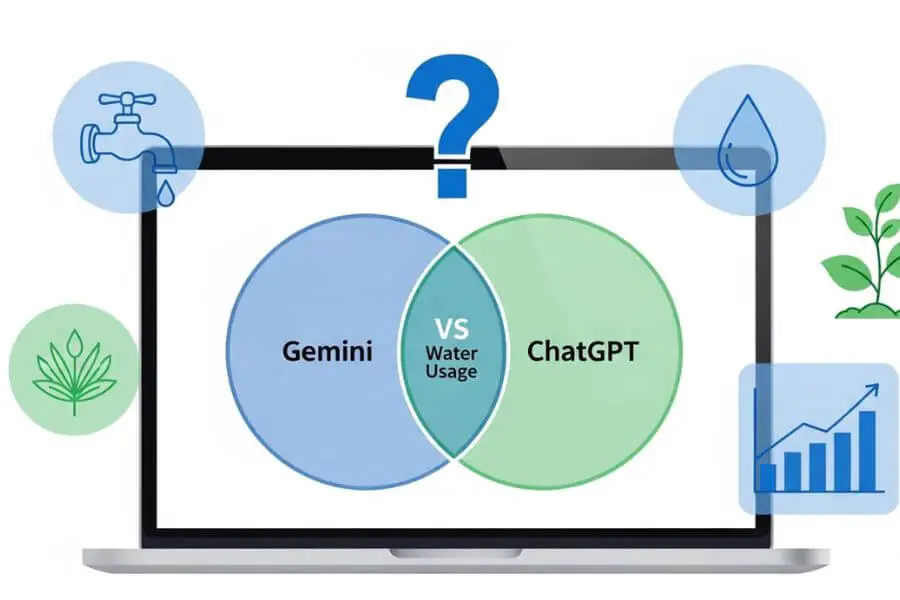
Does Gemini use as much water as ChatGPT? It is a just and more and more significant comparison with the growth of competition on the market of generative AI. The terse: perhaps more, but less available to the public.
Gemini (Google DeepMind) and Google Infrastructure
Gemini is also based on the TPU (Tensor Processing Unit) infrastructure of Google with its own world-wide data centre network. Google has in the past been among the more open large technology firms regarding its impact on the environment. According to the Environmental Report published by the company in 2024, AI-related workloads began to make a significant contribution to the increasing energy and water use at the company.
In 2022, Google used about 5.6 billion gallons of water, compared to 4.3 billion gallons of water in 2021. Similar to Microsoft, this growth is in line with the intensive AI development phase. Google does not report specific water usage of Gemini, but due to the size of the model and its worldwide availability, the number of queries per capita will be similar to ChatGPT, perhaps larger in certain locations of deployment.
A Side-by-Side Comparison: ChatGPT vs. Gemini
| Factor | ChatGPT (OpenAI/Microsoft) | Gemini (Google) |
| Infrastructure | Microsoft Azure | Google Cloud (TPUs) |
| Water per query (est.) | ~10-100 ml | ~10-120 ml (estimated) |
| Parent co. water use (2022) | 6.4M cubic metres (Microsoft) | 5.6B gallons (Google) |
| Transparency level | Low (limited disclosure) | Moderate (annual report) |
| Efficiency focus | PUE + liquid cooling | CFD-optimised cooling |
| Renewable energy | Growing commitment | Carbon-neutral since 2007 |
Google does have a more history of water efficiency innovations, such as utilizing machine learning itself (through DeepMind) to optimize data centre cooling which is reportedly resulting in a 40 percent decrease in the energy used in cooling in some of their facilities. This will depend on whether they will use air-side economisers (which will lead to a proportional reduction in water use) or wet evaporative cooling (which will mean water consumption).
Real-World Case Study: Microsoft’s Iowa Data Centres
Among the most captivating examples of AI-based water use, a research paper is not the one that should be mentioned but rather investigative journalism. In 2023, the West Des Moines Water Works, in Iowa, the USA, revealed that a cluster of Microsoft data centres in the area recovered about 11.5 million gallons of water within one month – July 2022 – a coincidence directly with intensive training of GPT-4 by OpenAI.
To put that in context:
- Some 11.5 million gallons are estimated to be 43.5 million litres.
- That is enough to fill 17,400 built domestic swimming pools.
- It is a major entrapment of a regional water supply which is used to provide domestic and agricultural needs.
- The data centre also purchased this water at an industrial price, a fact that cast doubts on the sustainability of this water, especially in the case of droughts.
The importance of this case is due to the fact that it is not an estimate, but a real, documented figure of a municipal water authority. It grants a grounding to the overall statistical estimates and proves that AI water consumption is not an abstraction on the global level, but a real strain on local infrastructure.
The same has been expressed in the UK where data centre arrays in places like West London and Slough utilize local bodies of water. As the UK faces more frequent bans, water bodies also face the problem of cumulative water demands of the data centres in a growing resource competition problem.
Why This Matters: Water Scarcity and AI Growth
The globe is not depleting its water in equal amounts, and instead, it is undergoing acute local water stress. It is approximated by the UN that the world will have more water demand than supply by the year 2030. It is on this background that the fast development of AI infrastructure has real implications.
The Geography of Risk
Not every data centre has an equal impact on water. The cost of the environment is much dependent on the location of the data centre:
- High-stress areas: Arizona, Nevada, Texas, and some of the Middle East are already stressed areas with data centres that use already strained aquifers and river systems. The opportunity cost of water consumed here is much greater than the opportunity cost of water consumed in, say, Norway.
- Mid-stress areas: Seasonal stress occurs in much of the United Kingdom, Central Europe, and the Midwest of the US. The demand during summer peaks due to AI cooling can be observed in conjunction with droughts and hosepipe bans.
- Less stressful areas: Nordic countries, and some components of the Canadian territory have greater water supply, and the lower ambient temperature also lowers the cooling pressure – which makes them even more appealing as development sites of sustainable data centres.
What Users Can Do
Single users lack direct bargaining power when it comes to decisions in the data centre infrastructure. Informed demand however does influence corporate behaviour, but there are practical considerations which are worth making:
- Use AI tools purposefully. Even useless or insignificantly brief sessions consume resources.
- Dilute support companies that have realistic sustainability goals and water reduction commitments that have been checked by the third party.
- Involve yourself in the policy debates regarding data centre planning especially when you are living in areas that may have new data centres.
- Select AI providers that release data on Water Usage Effectiveness (WUE) with their Power Usage Effectiveness (PUE) measurements.
How the Industry Is Responding: Efficiency Innovations
To be just to AI developers and data centre operators, there is a real innovation that is being undertaken to lower water consumption. These are motivated by a combination of environmental commitment, regulatory pressure and pure cost of water in the water-stressed markets.
Cooling Technologies of the Future
- Direct liquid cooling (DLC): Cooling is not done to the air surrounding servers but rather coolant is sprayed directly over chips. It decreases (or removes) dramatically evaporative water consumption and enhances thermal performance.
- Rear-door heat exchangers: These are water-cooled doors fitted on server racks that extract heat at the source, allowing less load to be placed on centralised cooling systems.
- Air-side economisers: In favourable climates, outside air is directly employed in the cooling process without the use of water especially during cooler temperatures.
- Closed-loop cooling: There are facilities that are now moving to a closed circle whereby water is recirculated as opposed to evaporation which is a big cut in net consumption.
- AI-optimised cooling (implemented by Google/DeepMind): Server heat loads are forecasted by AI, and cooling is adjusted in advance, minimising energy and water wastage.
The Role of Water Usage Effectiveness (WUE)
WUE is the data centre water efficiency metric, which is expressed in litres of water per kilowatt-hour of energy by the IT equipment. A WUE of 1.0 will imply that 1 litre of water will be used in 1 kWh of computing. The leaders in the industry are aiming at the number of WUE that is lower than 0.5 with some innovative facilities even achieving close to zero water usage in the colder regions.
| WUE Level | Classification | What It Means |
| < 0.5 L/kWh | Excellent | Best-in-class, frequently utilizes closed-loop/air cooling |
| 0.5-1.0 L/kWh | Good | Above industry average |
| 1.0-2.0 L/kWh | Average | Characteristic of most large facilities |
| > 2.0 L/kWh | Poor | Large use of water, usually old-fashioned or desert buildings |
Actionable Tips: How to Reduce Your AI Water Footprint
Although macro-level change takes corporate and policy action, individuals and organisations can take practical steps to decrease their AI water footprint.
For Individual Users
- Batch your queries. Rather than using 10 different short messages, combine all your queries in a well-constructed prompt.
- Use the correct model to do the task. Minor and more efficient models (such as GPT-4o mini or Claude Haiku) are much less compute-intensive and consequently less water-intensive.
- Unnecessary regeneration should be avoided. When a response is similar to what you want, edit it instead of starting to generate it again.
- Avoid image generation on queries that can be done in text mode – image generation is much more computationally expensive.
For Businesses and Developers
- Select AI API vendors publicizing validated WUE and PUE information.
- Look at the geographic location of your computer region that you are deploying to, EU and Nordic are generally less water-intensive.
- Use token caching techniques to prevent the re-processing of the same or similar prompts.
- Carry out regular audits on the use of AI to determine inefficiencies and avoidable compute overhead.
- Report on AI water use in your company Environmental, Social, and Governance (ESG) reporting.
Frequently Asked Questions
1. Does ChatGPT Consume Water Each Time a Message is Sent?
Yes. All requests done on ChatGPT will have to be computed on such data centre servers producing heat. Cooling such servers evaporatively or otherwise is a service that uses water. The size per single query is minor but scales with a lot of significance.
2. How Much Water Does ChatGPT Use Per Question?
How much water does ChatGPT use per question depends on the model, location, and load, although researchers estimate that between 10 and 100 millilitres of water are consumed per query. Considering the amount of communication in a chat of 20-50, it could take up the volume of a regular 500ml bottle of water.
3. How Much Water Does ChatGPT Use Per Day Globally?
How much water does ChatGPT use per day around the world is estimated to be hundreds of thousands up to possibly millions of litres, on average, depending on the number of active users each day and the average length of session. OpenAI does not disclose the figure; however, based on the estimation and the reported water usage of Microsoft, there is a strong indication that it uses a lot of water each day.
4. Is AI Water Consumption a Serious Environmental Issue?
Yes, especially in water-deprived areas. Competitors of AI data centres are residential, agricultural, and industrial water users. The aggregate water demand is a real sustainability challenge, and as AI is being picked up, regulators, communities, and technology companies are increasingly asked to respond to the challenge of increasing water demand.
5. Does Gemini Use as Much Water as ChatGPT?
Does Gemini use as much water as ChatGPT? Per query estimates are generally similar, but Google might have an edge in certain facilities due to its longer focus on cooling efficiency, such as AI-optimised cooling. Both companies do not show their product-level water consumption.
6. Which is the AI Model That Consumes the Least Amount of Water?
Smaller and efficient models tend to consume less water per query compared to the larger ones. All models such as GPT-4o mini, Claude Haiku, or Gemini Flash are optimized and require much less compute and consequently less water to complete a task in comparison to full-size flagship models.
7. Is There a Difference in Water Consumption Based on a Data Centre Location?
Significantly. In hot arid climates, data centres require greater amounts of water to cool than at colder climates. At least the Nordic countries and some parts of Canada and Northern Europe have natural ambient cooling which avoids the use of water intensive evaporative cooling.
8. Do You Use Water to Train or Only to Use ChatGPT?
Both. The large language model such as GPT-4 is trained only once, and the training is water-consuming with gigantic quantities. Continuous inference – what you use every day with the chatbot – uses water constantly. Cumulative inference water use at scale is also likely to be comparable to or greater than training water use during the lifespan of the model.
9. What is WUE and How is it Relevant to AI?
The effectivity of water usage is calculated as litres of water used per kilowatt-hour of the IT equipment energy into the Water Usage Effectiveness (WUE). It is the main water efficiency benchmark of the data centres. Reduced WUE implies that a substantial amount of water is used per unit of computing. WUE data is one of the indicators that should be evaluated when the claims of sustainability by AI providers are evaluated.
10. Is it Possible That AI Corporations Could Use Less Water?
Yes, and most of them are spending it. Direct liquid cooling, closed-loop water systems, AI-driven cooling optimisation and air-side economisers are all currently being implemented in varying sizes. Nevertheless, there is a high rate of AI demand; it is possible that the absolute water consumption can be increased regardless of the rise in its efficiency.
Conclusion: Does ChatGPT Use Water And What Should We Do About It?
Does ChatGPT use water? Definitely — and on a scale that is sufficiently serious to merit serious attention on the part of users, businesses, policymakers, and even AI developers themselves. Starting with the physics of evaporative cooling to the reported 34 percent increase in the water usage of Microsoft, the point is obvious: generative AI is not a no-friction technology. It has a physical footprint.
The main numbers should be remembered: about 10 to 100 millilitres per query, possibly millions of litres per day at the international scale, and a curve that will only rise as more people use it. These figures have real significance when placed in the context of growing water stress in the world.
All this does not imply that you must abandon the use of AI tools. It consists in their utilization with perception – going to significant transparency and effectiveness criteria – of the businesses that assemble and operate them. Ask for WUE data. Sustainable support providers whose sustainability is verifiable. Use models efficiently.
It is no longer a discussion of AI and the environment only concerning carbon emissions. The next frontier is water, which is already coming.