
Introduction: Is Hard Water Silently Damaging Your Home?
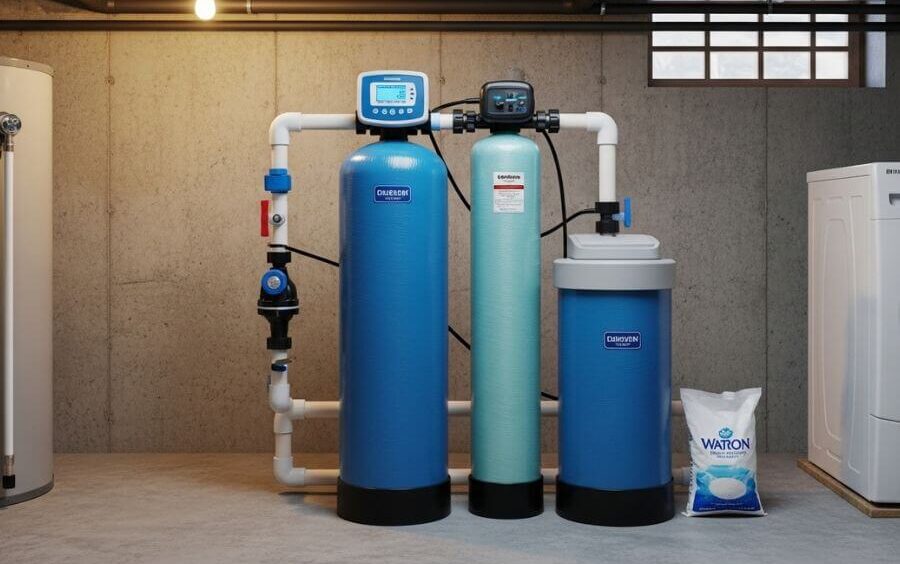
A water softener system is a whole-house filtration unit that removes calcium and magnesium minerals from your water supply the two culprits behind what we call ‘hard water.’ If you’ve noticed chalky residue on your taps, stiff laundry, dull skin after showering, or appliances breaking down ahead of schedule, hard water is likely the cause. In the UK, over 60% of homes sit in hard or very hard water zones. In the US, the figure is even higher the US Geological Survey estimates that 85% of American homes have hard water to some degree.
This guide goes beyond the basics. Whether you’re weighing up the water softener system installation cost, comparing brands like the Culligan water softener system, or simply trying to find the best water softener system for a three-bedroom semi in Manchester or a ranch house in Texas this article gives you the real-world detail you need to make the right call.
What Is a Water Softener System and How Does It Work?
At its core, a water softener works through a process called ion exchange. Hard water passes through a tank filled with resin beads, which are charged with sodium ions. As the water flows through, calcium and magnesium ions swap places with sodium ions on the beads. The result: softened water free of the minerals that cause scale, scum, and damage.
The Key Components
- Mineral tank: Where ion exchange actually happens
- Brine tank: Holds the salt solution used to regenerate resin beads
- Control valve: Monitors water usage and triggers regeneration cycles
- Bypass valve: Lets you isolate the softener for maintenance
Modern systems are far more intelligent than the units sold a decade ago. Salt-efficient models from brands like Kinetico and Harvey Water Softeners (popular in the UK) use twin-cylinder designs that regenerate on demand rather than on a timer meaning they never run out of soft water and waste far less salt.
UK Hard Water Zones at a Glance
| Region | Water Hardness (mg/L CaCO3) | Softener Recommended? |
| London & South East | 300–400 (Very Hard) | Strongly Yes |
| East Anglia | 250–350 (Hard) | Yes |
| Midlands | 150–250 (Moderately Hard) | Yes |
| North West England | 50–150 (Soft–Moderate) | Optional |
| Scotland & Wales | 0–100 (Soft) | Usually No |
| South West England | 100–200 (Moderate) | Recommended |
Source: Drinking Water Inspectorate (DWI), 2025 data
Water Softener System for Home: Which Type Is Right for You?
Choosing the right water softener system for home use isn’t just about brand names. It comes down to water hardness levels, household size, plumbing configuration, and budget. Here’s a breakdown of the main types available to homeowners in 2026.
1. Salt-Based Ion Exchange Softeners
The most widely installed type. They’re highly effective and handle even very hard water. Running costs involve buying salt — roughly £80–£150/year in the UK or $80–$150/year in the US depending on usage. Ideal for families of 3 or more.
2. Salt-Free Water Conditioners
Technically not softeners they don’t remove minerals, they alter their structure so they don’t stick to surfaces. Less effective for severe hardness but a good option where sodium output is a concern (elderly residents, low-sodium diets, certain environmental regulations).
3. Dual-Tank Softeners
Best for large households or commercial settings with high water demand. One tank softens while the other regenerates, so soft water is always available. Brands like Kinetico and Autotrol make reliable dual-tank units.
4. Magnetic / Electronic Descalers
Clip onto your pipes and claim to alter mineral behaviour through electromagnetic fields. The scientific evidence is mixed at best. Fine as a low-cost supplement but not a true replacement for an ion exchange unit in hard water areas.
Water Softener System Installation Cost: What to Budget in 2026
The water softener system installation cost varies significantly depending on unit type, household size, and whether you’re in the UK or US. Here’s a realistic breakdown based on current market data.
| System Type | Unit Cost (UK) | Unit Cost (US) | Installation | Annual Running Cost |
| Entry-level salt-based | £300–£500 | $300–$600 | £150–£250 | £80–£120 (salt) |
| Mid-range (twin-cylinder) | £700–£1,200 | $700–$1,200 | £200–£350 | £100–£150 |
| Premium (Kinetico/Harvey) | £1,200–£2,000 | $1,500–$3,000 | £300–£500 | £100–£160 |
| Culligan full-service | £1,500–£2,500 | $1,500–$3,500 | Included | Varies (rental option) |
| Salt-free conditioner | £200–£600 | $200–$800 | £100–£200 | Minimal |
| Magnetic descaler (DIY) | £30–£100 | $25–$100 | DIY | None |
Note: Installation costs assume a standard ground-floor installation near the stopcock/main water line. Loft or awkward access can add £100–£200 to the labour bill.
In the US, many homeowners choose professional installation through their county water authority or a licensed plumber. Always check whether your installer is WQA-certified (Water Quality Association) in the US or WIAPS-approved in the UK.
Culligan Water Softener System: Is It Worth the Premium?

The Culligan water softener system range has been a household name in North America since 1936 and has grown its UK and European presence significantly in the last decade. What sets Culligan apart isn’t just the hardware it’s the service model.
What Culligan Offers
- Customised water testing and site surveys before installation
- Both purchase and rental options (ideal for renters or those who don’t want upfront cost)
- Ongoing service contracts with regular salt delivery and system checks
- Smart Home Water systems with app-based monitoring (Culligan Connect)
- Warranty coverage up to 10 years on some models
Culligan Pricing at a Glance
Rental plans in the US typically run $25–$50/month including salt delivery and servicing. Outright purchase of a Culligan HE (High Efficiency) softener starts at around $1,500 before installation. In the UK, Culligan operates through regional dealers and pricing is mostly quote-based.
Where Culligan Excels
Culligan performs best for homeowners who want a fully managed service rather than a DIY setup. If you’re not inclined to manage salt top-ups, maintenance schedules, or regeneration settings, the Culligan service model removes that headache entirely. Their high-efficiency units can reduce salt and water use by up to 46% compared to older conventional models.
Where Culligan Falls Short
Cost. You’re paying a significant premium for the brand and the service. There are excellent independent alternatives — particularly in the UK, where Harvey Water Softeners, Kinetico, and BWT have loyal followings — that offer comparable performance at lower prices.
Best Water Softener System Comparison: Top Picks for 2026
When evaluating the best water softener system for your home, the key metrics to weigh are grain capacity, salt efficiency, regeneration type, and warranty. Here’s how the leading options stack up.
| Brand / Model | Type | Grain Capacity | Best For | Approx. Cost (US) | Rating |
| Culligan HE Softener | Salt-based | 20,000–64,000 | Service-focused buyers | $1,500–$3,500 | 4.5/5 |
| Harvey TwinTec S4 | Twin-cylinder | Custom | UK hard water areas | £1,300–£1,800 | 4.7/5 |
| Kinetico Premier | Non-electric twin | Custom | High-demand households | $2,500–$4,000 | 4.6/5 |
| Fleck 5600SXT | Salt-based (timer) | 24,000–64,000 | Budget DIY install | $400–$700 | 4.3/5 |
| SpringWell SS4 | Salt-based | 32,000–80,000 | Mid-range US homes | $800–$1,100 | 4.5/5 |
| Eddy Electronic Descaler | Magnetic (no salt) | N/A | Mild hard water, renters | $80–$180 | 3.5/5 |
Grain capacity refers to how many grains of hardness minerals the unit can remove before needing to regenerate. A grain is 1/7,000th of a pound of mineral. A family of four in a hard water area typically needs at least a 32,000-grain unit.
Real-World Example: A South London Family’s Experience
The Carter family, based in Croydon (one of London’s hardest water zones at around 360 mg/L), had been fighting for years. Their boiler engineer warned them in 2023 that their heat exchanger was already showing significant build-up after just six years. Their dishwasher clouded up glassware within weeks of a full clean. Skin complaints from their youngest were ongoing.
After getting quotes from three companies, they installed a Harvey TwinTec S4 in early 2024. Total outlay: £1,650 including installation. Within three months, they noticed:
- No new limescale on taps or showerheads
- Glassware came out of the dishwasher spotless
- Their boiler’s annual service showed zero new scale accumulation
- Soap and shampoo lathered better, reducing usage by roughly 30%
- Their youngest’s eczema-like symptoms reduced noticeably
The plumber who carried out their subsequent boiler service estimated that the softener would extend the boiler’s life by at least 5 years — a saving of £2,000–£3,000 in replacement costs alone. The payback period for the softener: under two years.
Step-by-Step Guide: Installing a Water Softener System at Home
This guide is for a standard salt-based ion exchange unit. Always consult a qualified plumber if you’re unsure about any stage.
Step 1: Test Your Water
- Order a free hard water test kit from your supplier or buy one from Amazon (cost: £5–£15)
- Test at the main kitchen tap — this gives the most accurate reading
- Note your result in mg/L or grains per gallon (GPG): 1 GPG = 17.1 mg/L
Step 2: Calculate Your Household Demand
- Multiply the number of people in your home by 80 (average daily gallons per person)
- Multiply that by your hardness in GPG
- Multiply by 7 (days per week) to get weekly grain load
- Choose a softener with a rated capacity at least 15–20% higher than this figure
Step 3: Choose Your Location
The softener should be installed as close to the water main entry point as possible — ideally before the supply splits off to the hot water heater. Leave the outdoor tap (if fitted) on the unsoftened line to avoid softened water being used for garden irrigation.
Step 4: Installation Day
- Shut off the main water supply
- Cut into the supply pipe and fit isolation valves either side
- Connect the softener via the inlet and outlet ports
- Connect the brine tank overflow and drain line to a suitable waste outlet
- Fill the brine tank with salt (block or granular — check manufacturer spec)
- Turn water back on, check for leaks, run a manual regeneration cycle
Step 5: Ongoing Maintenance
- Check salt levels monthly never let the brine tank run dry
- Use the correct salt type (block salt is common in the UK; pellet salt in the US)
- Clean the resin tank with a resin cleaner annually
- Test your output water hardness every 6 months to verify performance
Health, Environmental, and Water Quality Considerations
Is Softened Water Safe to Drink?
Softened water contains slightly elevated sodium levels typically 20–30mg per litre depending on incoming hardness. For most healthy adults, this is well within safe limits. NHS guidance and the WHO agree that softened water is safe for general drinking. However, those on sodium-restricted diets, infants, and people with specific kidney conditions should drink from an unsoftened tap or use a reverse osmosis filter for drinking water.
Environmental Impact
Salt-based softeners produce brine wastewater during regeneration. In the US, some California counties have historically restricted or banned water softener installation due to concerns about water reclamation facilities. In the UK, there are currently no blanket bans, but modern efficient models produce significantly less waste brine than older units. Salt-free conditioners have no environmental discharge at all.
Does Softening Affect Boilers and Plumbing?
Softened water is compatible with all standard plumbing materials including copper, plastic, and stainless steel. It will not corrode pipes under normal conditions. The Water Regulations Advisory Scheme (WRAS) in the UK certifies softeners that are safe for connection to the mains always check for this mark.
7 Expert Tips Before You Buy
- Get a water test first don’t guess at your hardness level
- Calculate your daily grain requirement accurately before sizing a unit
- Budget for installation separately don’t assume it’s included
- Ask for WQA certification (US) or WRAS approval (UK) on any unit you buy
- Compare quotes from at least 3 installers water softener system installation cost varies more than you’d expect by region and installer
- Choose metered regeneration over timed regeneration it saves salt and water
- Read the warranty carefully: resin tank and control valve warranties differ
Frequently Asked Questions
1. How much does a water softener system cost to run per year?
Running costs depend on water hardness and household size, but typically range from £80–£150/year in the UK and $80–$150/year in the US. This covers salt purchases. Electricity for the control valve is negligible — most units use less than £10 worth per year.
2. Does a water softener system remove chlorine or other contaminants?
No. Standard softeners are designed specifically to remove calcium and magnesium via ion exchange. They do not filter chlorine, heavy metals, bacteria, or nitrates. If you need broader water purification, you’ll need a separate filtration system — such as a carbon filter or reverse osmosis unit in addition to your softener.
3. How long does a water softener system last?
A good quality unit should last 10–20 years with proper maintenance. The resin inside may need replacing every 10–15 years. Control valves and seals are typically the first components to wear and are usually serviceable. Twin-cylinder non-electric models (like Kinetico) tend to have longer operational lifespans due to fewer electronic components.
4. Can I install a water softener system myself?
Technically yes, if you have basic plumbing skills and your local building regulations permit it. In the UK, you must notify your water company before installation this is a legal requirement under the Water Industry Act 1991. In the US, requirements vary by state and municipality. For warranty and insurance purposes, professional installation is strongly recommended.
5. Will a water softener system lower my energy bills?
Indirectly, yes. Scale build-up on heating elements forces boilers and water heaters to work harder. Research from the Battelle Memorial Institute found that a gas water heater operating in hard water lost roughly 22–29% of its efficiency over 15 years. Softened water prevents that build-up, maintaining efficiency over time.
6. Is the Culligan water softener system worth the money?
It depends on your priorities. If you value a fully managed, hands-off service with professional support, the Culligan model is excellent. If you’re comfortable managing your own system and want maximum value for money, independent brands — particularly Harvey and Kinetico in the UK, or Fleck and SpringWell in the US — offer comparable performance at meaningfully lower cost.
7. What is the best water softener system for a 4-bedroom house?
For a family of four to five in a hard water area, look for a unit with at least a 48,000–64,000 grain capacity. In the UK, the Harvey TwinTec S4 or Kinetico Premier are strong choices. In the US, the Culligan HE series or SpringWell SS4 cover this demand comfortably. Always verify against your actual water hardness reading.
8. How long does water softener system installation take?
A standard installation by a professional plumber takes 2–4 hours. More complex installations — particularly in older properties with difficult pipe access may take a full day. Most installers will visit in advance to assess the site and confirm the quote before booking the job.
9. Can I use softened water for my garden?
It’s not recommended for regular garden use. The elevated sodium content in softened water can accumulate in soil over time and affect soil structure and plant health. Most plumbers will install a separate unsoftened feed to your outdoor tap specifically for this reason. If a separate feed isn’t possible, use a salt-free conditioner instead.
10. Do I need planning permission to install a water softener system in the UK?
No, planning permission is not required. However, you must notify your water supplier — typically via a simple form — before installation. The unit must be WRAS-approved to be legally connected to the mains supply. Failure to notify can technically void your water supplier agreement, though enforcement is rare.
Conclusion: Making the Right Investment for Your Home
Hard water is one of those household problems that costs money slowly and silently in boiler repairs, appliance lifespans, cleaning products, and skin and hair health. A good water softener system addresses all of those issues at the source.
The right choice comes down to your water hardness level, household size, budget, and how hands-on you want to be with maintenance. Budget DIY installs using a Fleck 5600SXT can deliver excellent results for under $700 in the US. Premium managed solutions from Culligan or Harvey offer peace of mind at a higher price point. And for UK homeowners in very hard water zones like London and the South East, the case for installation is particularly strong the return on investment, when you factor in boiler longevity alone, is often under two years.
Whatever you decide, get your water tested first, size the unit correctly, and use a certified installer. Take the guesswork out of it. A properly chosen and installed water softener system will serve your home reliably for 10–15 years — and you’ll notice the difference from day one.