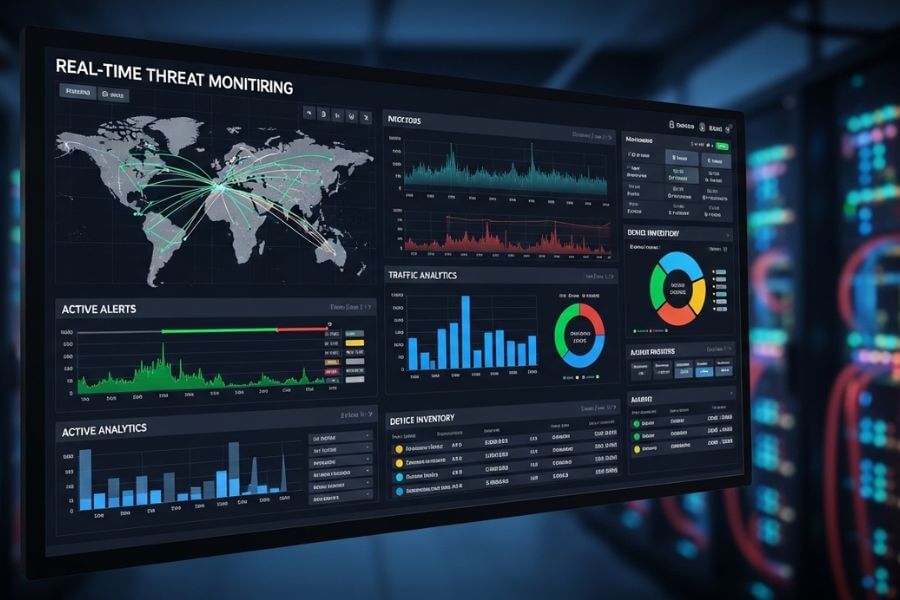
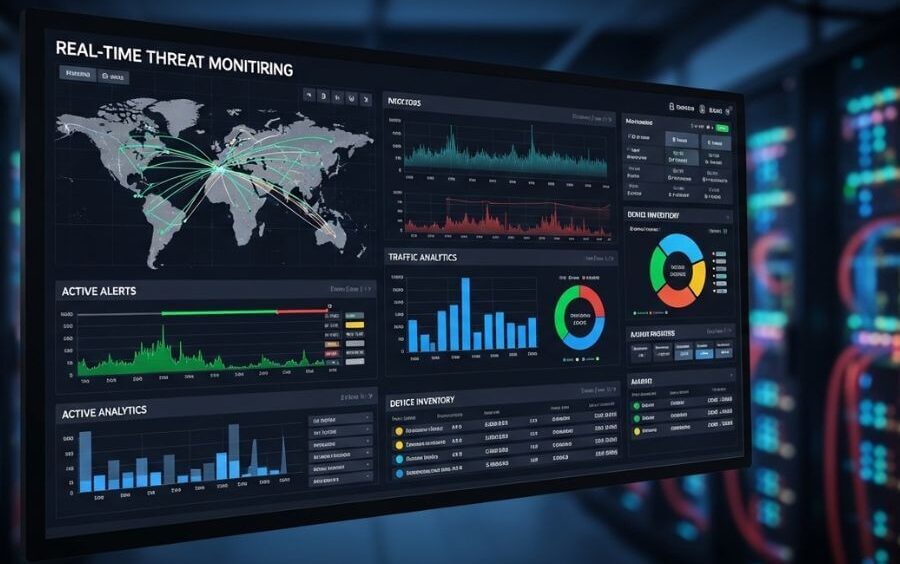
Network security monitoring is being revolutionized by Artificial Intelligence (AI), which no longer employs conventional signature-based techniques. The current network security monitoring tools take advantage of AI and machine learning to monitor in advance the cyber threat, process big network traffic data, and indicate the anomalies that could be overlooked by a person or a fixed system. This change enables organizations to keep an eye on their infrastructure, including on-premise networks, cloud, and edge environments, to ensure protection in real-time and quick response.
The Network Security Monitoring Tools.
Network security monitoring tools keep track of the network traffic in order to identify threats, vulnerabilities, and unusual activities. These are tools that allow 24/7 visibility instead of the point-in-time scanners, which ensure that security teams can neutralize attacks before they get out of control. The current monitoring systems are hybridized with AI and packet capture, flow server, and SIEM systems to deliver a holistic security posture. The selection of tools will be determined by the size of the organization, the complexity of the infrastructure, and the compliance.
Key Features to Look For
- Constant tracking and reporting of the network traffic.
- Anomaly detection based on AI to detect threats that are unknown.
- This is centralized intelligence, which gets integrated with SIEM or NDR platforms.
- On-premise, cloud,and hybrid scalability.
Network Security Monitoring Tools Comparison Table
| Tool/Category | Key Features | Pros | Cons | Ideal Use Case |
| Wireshark | Packet capture & protocol analysis | Free, extensive documentation | Resource-intensive, steep learning curve | Troubleshooting & forensic analysis |
| tcpdump | CLI packet capture | Lightweight, scriptable | No GUI, limited features | Remote servers, scripting |
| Attaxion | NetFlow & exposure monitoring | Agentless, external monitoring | Cost scales with assets | External threat detection |
| SolarWinds NTA | NetFlow traffic analysis | Bandwidth insights, reports | Expensive, setup complexity | Enterprise bandwidth & anomaly monitoring |
| Snort | NIDS/NIPS | Industry standard, open-source | False positives require config | Intrusion detection & prevention |
| Suricata | NIDS/NIPS multi-threaded | Scalable, high-performance | High false positives | High-traffic networks |
| Zeek | Network traffic analyzer | Behavioral analysis, customizable | Needs scripting knowledge | Advanced traffic monitoring |
| Security Onion | All-in-one NSM suite | Full visibility, dashboards | Hardware intensive | Enterprise NSM deployment |
| Darktrace | AI-powered NDR | Self-learning AI, real-time response | Expensive, complexity | Autonomous threat detection |
| Vectra AI | Behavior-based analytics | Reduces alert noise, focuses on critical threats | Costly for small setups | Threat prioritization & response |
| Wazuh | SIEM/XDR | Real-time monitoring, compliance support | Some integration issues | Cost-effective SIEM solution |
| Splunk Enterprise | SIEM | Large ecosystem, scalable | High cost, complex for beginners | Enterprise SOC monitoring |
Network Security Monitoring Tools Categories.
Monitoring tools of network security may be classified as having five major hinges that serve other purposes of network and system protection. These are packet capture tools, NetFlow analyzers, NIDS/NDR platforms, SIEM systems, and AI-based threat detection tools. This combination is guaranteed to provide deep visibility, proactive response to threats, and actionable insights.
Packet Capture Tools
Intercept and scan all data packets across the network, and afford forensic-level visibility. Wireshark and tcpdump are some of the tools that aid in analyzing traffic patterns, troubleshooting problems, and identifying malicious activity on a packet-by-packet basis.
NetFlow Analyzers
Keep track of network traffic metadata to develop normal behaviors and identify abnormal behaviors. They can be SolarWinds NetFlow Traffic Analyzer or Attaxion, and have external threat monitoring and asset discovery.
NIDS/NDR Solutions
Network Intrusion Detection Systems (NIDS) such as Snort and Suricata work passively, and Network Detection and Response (NDR) systems such as Darktrace and Vectra AI identify and respond to attacks in real time using AI/behavioral analytics.
SIEM Platforms
Logs on all IT infrastructure that could be overlaid so that security can analyze events centrally. The Wazuh and Splunk Enterprise Security platforms offer in-depth insights, threat correlations, and compliance reporting.
AI-Driven Monitoring Tools
The AI incorporates predictive analytics, anomaly detection, and automated threat response. The tools make them faster to detect and less likely to give false positives, as well as give actionable intelligence to security teams.
Best Practices: Network Monitoring Continuously.
It is important to monitor constantly to notice threats in time. Placing several tools together to offer a layered security approach, automation of alerts, and behavior-driven threat detection with the help of AI should be utilized by organizations. The rulesets must be updated regularly, and audits conducted, and monitoring coupled with incident response plans will provide a high level of protection.
The Multi-Layered Security Implementation.
A combination of packet capture, NetFlow, NIDS/NDR, and SIEM is comprehensive. All the tools are complementary, and no loopholes in monitoring exist.
The Threat Detection Automation.
Use AI-driven solutions to automatically identify suspicious behavior, prioritise alerts, and take mitigation actions, eliminating manual overheads and response times.
Updates and Compliance.
Keep signatures, rules, and threat feeds up to date. Regulatory frameworks such as PCI DSS, HIPAA, and GDPR have the advantage of regular monitoring and reporting.
Conclusion
In present-day organizations, network security monitoring tools are necessary to secure their digital assets. There is no one tool that will address all the requirements, and packet capture, NetFlow analysis, NIDS/NDR, AI-based platforms, and SIEM systems are the solutions to offer a layered security. The keys to being ahead of cyber threats and ensuring the compliance and the efficiency of operations are continuous monitoring, AI-led insights, and proactive reaction to the threat.
Frequently Asked Questions
Q1: What are network security monitoring tools?
Network security monitor tools are used to constantly monitor the activities within the network to identify threats, anomalies, and possible breaches. They assist companies in being proactive in securing systems and also reacting to attacks.
Q2: What are the most effective network security monitoring tools?
The best tools are Wireshark, tcpdump, SolarWinds NTA, Snort, Suricata, Darktrace, Vectra AI, and Splunk. All of them have their purposes, such as packet capture or even AI-based threat recognition.
Q3: What is the way that I continuously monitor systems with the help of network security tools?
Monitoring continually entails the need to combine various tools such as NIDS/NDR, SIEM platforms, and AI analytics. This setup comes with 24/7 visibility and quick incident discovery.
Q4: What is the distinction between NIDS, NDR, and SIEM tools?
NIDS are passive intrusion detection systems, NDR is based on AI and behavioral analytics to react to threats, and SIEM consolidates logs to provide central security-related knowledge about systems.
Q5: Do open-source network security monitoring tools work?
Yes, there are strong monitoring tools available at no cost, such as Wireshark, tcpdump, Zeek, and Suricata. They offer enterprise-level security when used together with commercial or AI-based solutions.